The best design does not always add things. Sometimes, it simply makes them disappear.
There is a curious paradox in contemporary design. For a long time, innovation was understood as the addition of more elements: more technology, more functions and more objects capable of demonstrating that a home was modern.
Some of the most relevant innovations of recent years, however, have followed the opposite path. They have removed, simplified and created space.
Doors disappear into walls. Lighting becomes part of the architecture. Sockets are concealed. Profiles are reduced to a minimum. Almost without noticing, the space itself regains its leading role.
Perhaps true luxury is no longer about adding more things, but about allowing architecture to breathe again.
When an object shapes an entire architecture
Some elements are so deeply embedded in everyday life that we stop questioning them. For decades, the extractor hood was one of them.
Suspended above the cooking area, it established the axis of the kitchen and conditioned the layout of the space. It was more than an appliance: it also acted as an architectural element. It determined heights, interrupted sightlines and restricted the freedom to design open kitchens.
As with so many inherited solutions, we assumed there was no other way.
Until someone decided to question the obvious.
The innovation was freeing the space
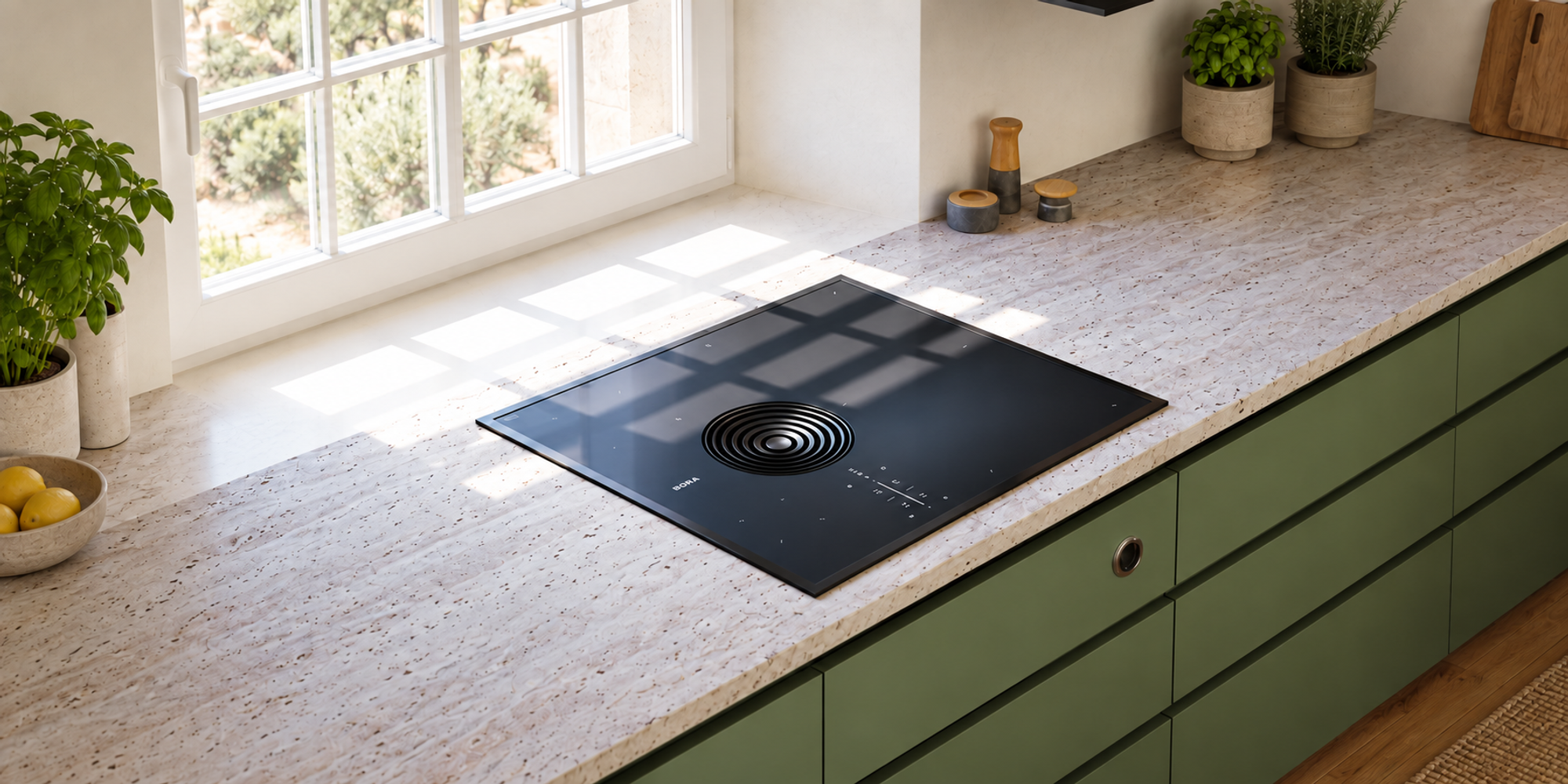
When BORA developed its surface extraction system, it did more than introduce a new technology. It reconsidered the relationship between the cooking area and the space around it.
By integrating extraction directly into the hob, vapours are captured where they are generated. The suspended hood is no longer necessary, the ceiling regains its continuity and sightlines remain open.
This difference is particularly significant in open kitchens, islands and spaces connected to the living or dining area. The cooking zone can occupy a central position without creating a visual barrier between the person cooking and the people sharing the space.
The technology does not disappear. What disappears is its need to impose itself on the architecture.
And when the space changes, so does the way we inhabit it.
Designing around what cannot be seen
There is a tendency in contemporary design that we find particularly interesting. The best projects rarely stand out because of the number of elements they contain. They stand out because of everything they have chosen to resolve, integrate or remove.
Fewer profiles. Less visual noise. Fewer interruptions. Fewer objects demanding attention.
This is not about pursuing minimalism as a style. It is about creating calm and clarity.
When the unnecessary disappears, proportions, materials and light become easier to understand. This idea extends far beyond the kitchen. It can be seen in a flush door, indirect lighting, integrated climate control or a cooking surface that no longer requires a suspended hood.
The result is not an empty space. It is a better-resolved space.
Technology at the service of space
For many years, product design pursued a very clear objective: to be seen. Today, the opposite is increasingly true.
The best technology improves an experience without constantly demanding our attention. It does not need to be displayed. It works quietly, integrated into the project and at the service of the people who inhabit it.
This shift in perspective is closely connected to the way we approach design at Studio2. A product ceases to be an isolated object when it begins to improve the architecture.
That is why we work with brands such as BORA: not only because of the performance of their integrated extraction systems, but because of the possibilities they offer when designing kitchens that are more open, coherent and free.
Technology is no longer the objective. It becomes a tool for designing better.
Space as the true luxury
Contemporary luxury may no longer be about introducing more objects. It may have much more to do with freeing space.
Allowing light to travel through a room without obstacles. Looking from one end of the home to the other without interruption. Cooking while maintaining a visual relationship with the people sharing the table, the living room or the rest of the house.
The contemporary kitchen is no longer necessarily an isolated room. It has become a meeting place and a central part of domestic life. Every element that conditions its relationship with the rest of the home must therefore be carefully considered.
The best innovations do not always attract attention. They often achieve precisely the opposite: they become so well integrated that we forget we ever designed in another way.
When technology disappears
Design is also about deciding what is unnecessary.
For decades, we assumed that every kitchen needed a hood suspended above the cooking area. Surface extraction systems demonstrated that the same need could be resolved differently.
This is one of BORA’s most important contributions: not eliminating extraction, but integrating it in order to free the architecture.
At Studio2, we believe every design decision should answer one very simple question:
Does this element genuinely improve the way we experience a space, or does it merely occupy one?
That is the conversation we like to begin whenever we start a new project.