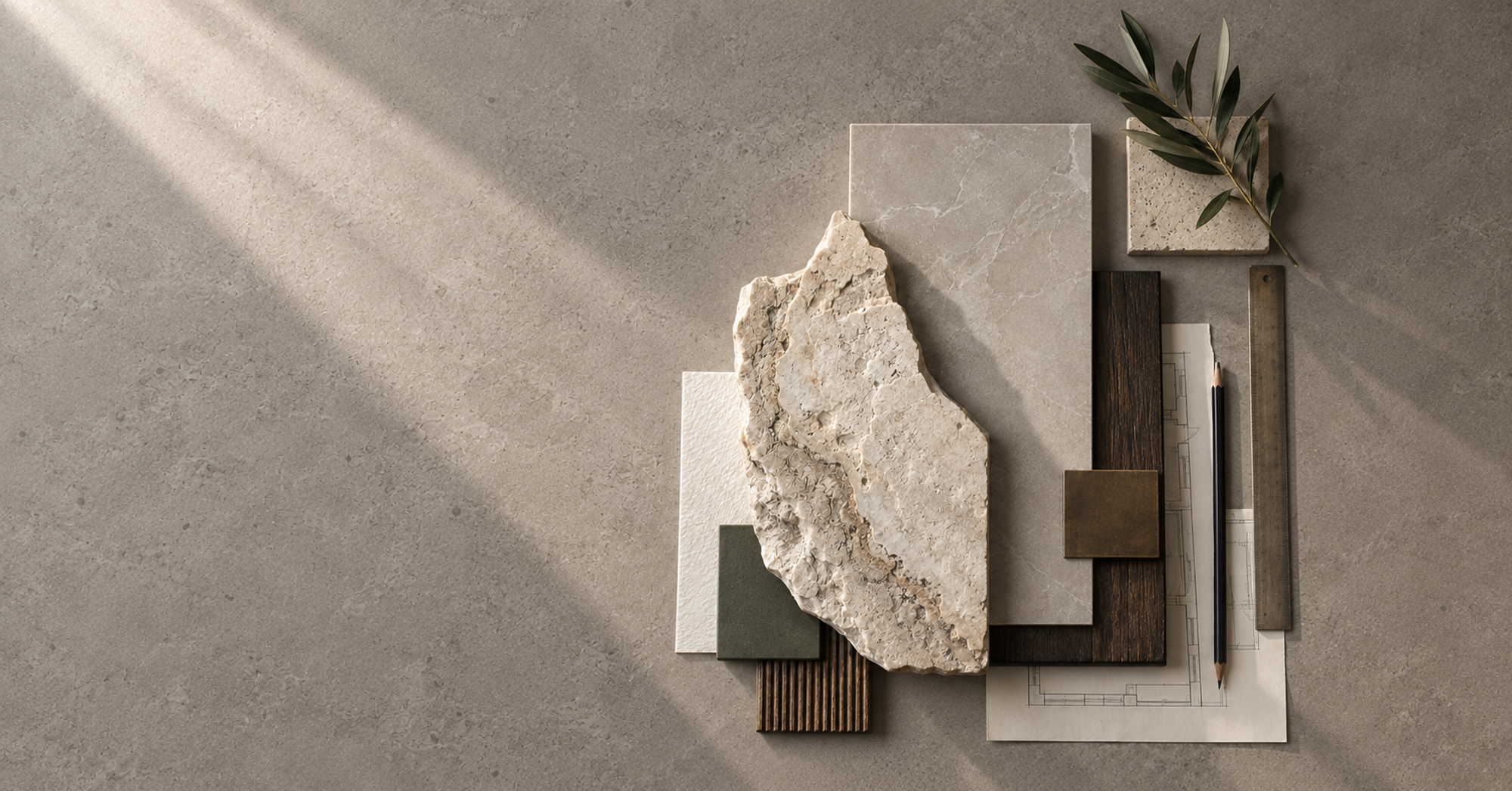
There is no perfect material. There is only the right material for each project.
Choosing the surface for a worktop, island or wall finish is one of the most important decisions in an architecture and interior design project. It shapes more than appearance: it also affects use, maintenance, ageing and the precision required during fabrication and installation.
One of the questions we hear most often at Studio2 is whether natural stone or porcelain is the better choice. There is no universal answer. Both can deliver an excellent result, but they respond to different priorities. The first step is to understand how the space will actually be lived in.
What we mean by natural stone
Natural stone is quarried and then cut and finished without changing its essential structure. Marble, granite, quartzite, travertine and limestone all belong to this family, but they do not behave in the same way.
Every slab is unique. Veining, tonal changes and small variations are part of its value. Porosity, hardness and sensitivity to acids also differ, so a granite or quartzite should not be specified in the same way as a marble or limestone.
What we mean by porcelain
Porcelain is a very low-porosity ceramic material manufactured at high temperatures and available in large-format slabs. It offers a wide range of finishes and can bring visual continuity to worktops, splashbacks, wall cladding and other surfaces.
Not every industrial large-format surface should automatically be placed in the same category. Some brands offer sintered or ultracompact materials with their own composition and performance. The specific technical sheet, thickness, finish and installation system must all be considered.
Advantages of natural stone
Uniqueness. No two pieces are exactly alike.
Material depth. Veining and variation are not merely surface prints.
Characterful ageing. When correctly selected and cared for, stone develops its own patina.
Architectural value. It brings authenticity and a direct relationship with material.
Good thermal behaviour. Performance depends on the type of stone, finish and installation.
Points to consider with natural stone
Some stones need sealing and periodic maintenance. Marble and other calcareous stones can react to everyday acids such as lemon, vinegar or wine. Absorption and scratch resistance also vary from one stone to another.
This does not make natural stone a poor choice. It means it must be selected with knowledge, and the client must understand and accept how it will evolve through use.
Advantages of porcelain
Low absorption and strong resistance to many everyday household stains.
Straightforward maintenance when the manufacturer’s guidance is followed.
A wide variety of finishes inspired by stone, cement, metal or timber.
Large formats that create continuity between worktops, splashbacks and wall surfaces.
Consistent performance when the product, thickness and installation are correctly specified.
Points to consider with porcelain
Execution is critical. Joints, mitres, cut-outs and edges require precise fabrication and installation. Edges can be vulnerable to impact and local repairs are often more complex.
Quality and performance vary between products. Appearance alone is not enough: the technical sheet, intended use and manufacturer’s recommendations should always be checked.
Choosing according to use
If you want a truly unique surface
Natural stone offers an unrepeatable expression and a depth that is difficult to reproduce.
If easy maintenance is the priority
Porcelain is often a particularly practical choice because of its low porosity, provided it is fabricated and installed correctly.
If the kitchen will be used intensively
Stain, impact and heat resistance, cleaning products, edge design and installation should all be assessed together. Porcelain can perform very well, but the complete detail matters.
If you appreciate patina and ageing
A carefully selected natural stone can age beautifully and make the history of the space visible.
If visual continuity is important
Large-format porcelain slabs can coordinate worktops and wall surfaces with fewer joints and a consistent language.
If the material will be used outdoors
Sun exposure, frost, movement, finish and installation must be assessed together. Not every product or every stone is suitable for every condition.
Which option costs less
There is no single answer. Cost depends on the stone or product, origin, thickness, format, cutting plan, edge details, openings and installation. Comparing only the price per square metre can hide an important part of the real project cost.
How we approach the decision at Studio2
At Studio2, we never recommend a material for appearance alone. We begin with use, cooking habits, acceptable maintenance, light, the relationship with the rest of the home and the project budget.
We work with both natural stone and technical surfaces because our aim is not to impose one answer. It is to make sure every choice belongs to the whole project and continues to make sense once the space is lived in.
Frequently asked questions
Which lasts longer, natural stone or porcelain
Both can offer a very long service life. Durability depends on the specific material, thickness, fabrication, installation, use and maintenance.
Which material requires less maintenance
In general, porcelain needs less attention because of its low porosity. Natural stone may require sealing and specific care depending on its composition.
Which is more resistant to stains
Porcelain generally offers very high resistance. With natural stone, performance depends on porosity, finish and the protection applied.
Can natural stone scratch
Yes. Quartzites and many granites are generally more scratch resistant than marbles and limestones, but every surface should be assessed according to real use.
Which should I choose for a kitchen island
The answer depends on size, overhangs, cut-outs, edge design, daily use and the relationship with the rest of the project. An island should be resolved as an architectural element, not as an isolated material sample.
The best choice depends on the project
Choosing between natural stone and porcelain is not about deciding which is better in the abstract. It is about finding the right balance between material, use, maintenance, execution and budget.
That answer will never be exactly the same for two projects.