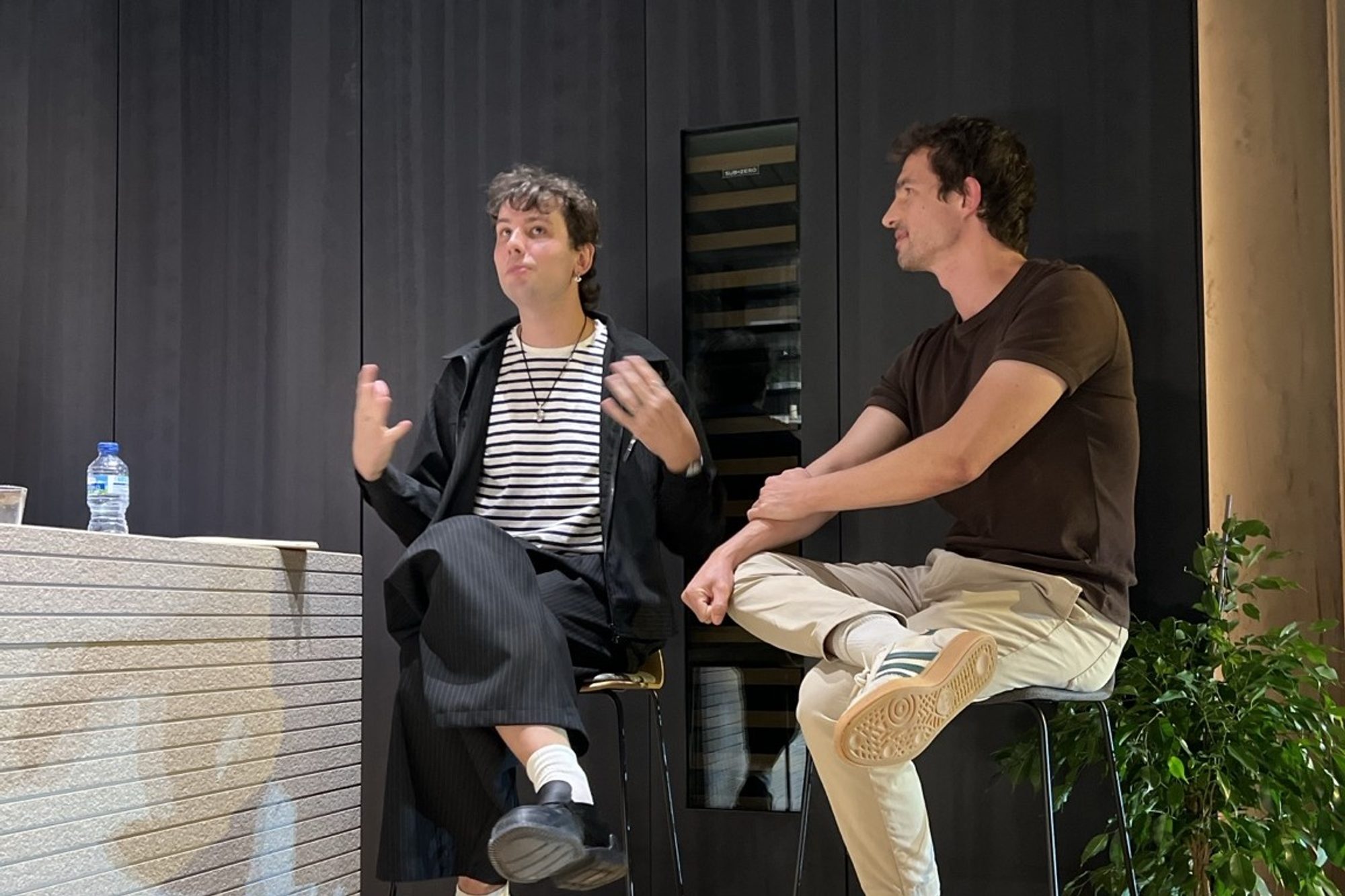
A kitchen, two perspectives and a conversation about the València we want to keep living in.
A haberdashery. Thread, needles, buttons. And also a place to learn to sew, meet other people and share what we know.
It may seem like a small starting point for discussing the future of a city. But around the Studio2 kitchen, this example led us to one of the afternoon’s central questions: how can we keep our neighbourhoods alive?
On Thursday 15 October, we welcomed Vicent Molins and Diego Blanco Prieto to the second conversation in Un lugar donde pasan cosas . We came to discuss tourism, housing, identity and urban marketing. We ended up imagining ice Fallas and lateen-sailing boats travelling through the streets of Cabanyal. In between, there were questions, shared experiences and a strong desire to think together.
Getting involved early
Vicent introduced an idea that ran through much of the conversation: we need to anticipate change. Take an interest in what is happening, learn about projects and participate while decisions can still be made.
We discussed short-term tourist rentals and how difficult it is to respond once a transformation has already taken hold in our neighbourhoods. References to Amsterdam and Barcelona opened a discussion about addressing tourist pressure through measures that make room for everyday life. Setting limits also means offering alternatives and supporting those who keep neighbourhoods alive.
During the dialogue, Javier Alonso García, from Valencia Plaza , offered a specific example: the refurbishment of the València Police Headquarters on Gran Vía Ramón y Cajal, a building designed by architect Javier Lahuerta Vargas.
The intervention, intended to improve the building’s energy efficiency, has also prompted debate about changes to its façade and the preservation of its architectural character. Fundación Goerlich has been among the voices critical of the result.
The case raised a question that extended beyond that building: when do we begin paying attention to the decisions transforming our city? Public discussion often begins once the work is complete, when the scope for intervention has already changed.
Learning about projects, understanding what is proposed and opening the debate in time are also ways of caring for the city. Improving its performance and preserving its identity are two needs that deserve to be considered together.
The life within a ground-floor space
Let us return to the haberdashery.
It was the concrete example that helped us discuss local businesses and the life they bring to neighbourhoods. A place to buy thread, needles and buttons can also offer classes, share knowledge and build community.
The reflection extended to neighbourhood businesses more broadly: the places we need nearby and which form part of our routines, relationships and neighbourhood identity.
From the audience, architect Sonia Rayos highlighted the importance of urban planning centred on citizens and their everyday needs, with street-level businesses as a source of neighbourhood life.
Her contribution encouraged us to consider which activities occupy ground-floor premises and how they relate to the street. A mixture of shops and everyday services —including a medical practice, an advisory firm or a professional office— is part of a lived-in neighbourhood. What happens when those needs become less visible and the street increasingly turns into a shop window for people passing through?
We discussed preserving commercial premises that sustain everyday life and helping businesses adapt and find new ways to remain relevant. Paying attention to what is small, what already exists and what creates value, even when it is not the most eye-catching.
What do we give back to a city from which we receive so much? The haberdashery helped us bring that question into everyday decisions: what we buy, which businesses we support and which initiatives we choose to join.
Loving the city also means getting involved
Vicent spoke with affection for València. For what it has been, what it is and what it may still become, and in which he hopes to continue recognising himself.
An affection that involves asking uncomfortable questions. During the conversation, he considered how the connection between gaining value from a city and contributing to it is weakening: what happens when we extract everything we can without giving back what it needs to remain liveable?
We also discussed public spaces and how they are used between one major event and the next. How to bring everyday life to a square, and how much attention a visible gesture receives compared with the discussion about what we actually need from that place.
The city changes, and we change with it. The challenge is to devise approaches that work, listen to those who live there and accept that building its future is a shared task.
Drawing a València that does not yet exist
Diego gradually steered the dialogue towards care, harmony, admiration and our ability to imagine.
Then we travelled into the future.
To a warmer València, with busy squares and new needs. We imagined clothing designed to withstand higher temperatures, lateen-sailing boats travelling through Cabanyal and ice Fallas that would melt away by themselves.
There was humour, of course. And also a way of approaching some serious questions: what will we be willing to change? How does a tradition adapt? What makes us continue to feel that we belong to a place when everything around it is changing?
Imagining that València allowed us to look again at the city before us. To consider its identity as something that also evolves, finds other forms of expression and responds to new realities.
Being part of a place also means giving back
Diego is from Navarra. He trained in València, lives here and has gradually built his relationship with the city through illustration and the gatherings organised by Ojo Garabato .
Bringing people together to draw in public space is a way of using it, paying attention to it and sharing it. During the conversation, he explained that he feels a responsibility as part of this València: participating is also his way of giving something back to the city.
That idea stayed with us. Because belonging to a place is also built through time, relationships and a willingness to contribute.
A conversation shaped by everyone
Around the kitchen were professionals from architecture, design and journalism, students and people curious about what was happening.
Contributions began from the outset. One question led to another, someone offered an example and the conversation found a new direction. There was reflection, humour and a welcoming atmosphere in which the experiences of the audience also had a place.
This is what we seek through Un lugar donde pasan cosas : a space where different perspectives can meet and where there is time to listen and participate.
Thank you, Vicent and Diego , for sharing your perspectives and opening so many questions. And thank you to everyone who gathered around the kitchen and made the conversation their own.
The event was organised by Studio2 , with the collaboration of ADCV and Open House Valencia . Our thanks also go to Treku Valencia for providing the speakers’ stools and elements to dress the space, and to Vinyco for providing drinks throughout the afternoon.
Things happen because we make them happen together.