The city we inhabit
To appreciate a city, we must first understand it. This idea ran through the first Un lugar donde pasan cosas conversation, featuring Sara Portela, director of Open House Valencia, and content creator and graphic designer Carlos Lluna.
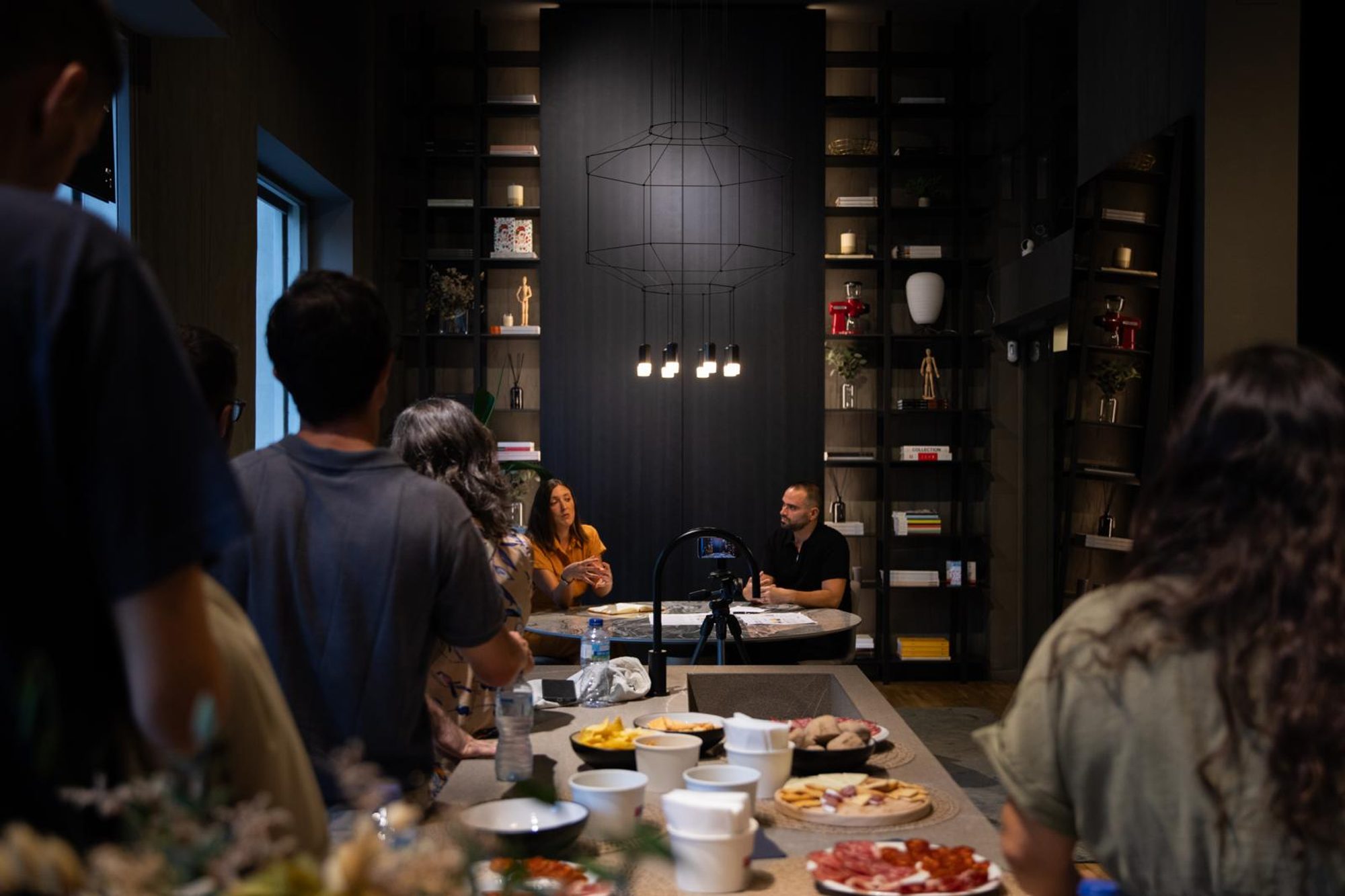
On Thursday 17 September, the Studio2 showroom opened its doors for a conversation about architecture that did not treat architecture as a subject reserved for specialists. Sara and Carlos sat at a round table. A few steps away, people from different disciplines gathered around the kitchen. The format did the rest: the distance between speakers and listeners soon disappeared.
The conversation began with Open House Valencia but soon moved towards a broader question: how we learn to look at the city, how heritage shapes our identity, and why knowing the reasons behind a building can completely change the way we value it.
From volunteer to director of Open House Valencia
Sara recalled her student years and a trip to Barcelona after an invitation from a friend. There she encountered an initiative that opened buildings and brought architecture closer to people who did not necessarily work in the field. In time, the idea reached Valencia. Sara began as a volunteer and now directs the festival.
The growth of Open House Valencia illustrates this opening up. The festival offers guided visits to buildings that are normally inaccessible or that we only know from the outside. What once seemed difficult to imagine has become an event eagerly awaited by the public. Going inside reveals scale, decisions, materials and ways of living that a facade alone cannot explain.
Understanding the decisions the city cannot show
One example emerged while discussing the remodelling of Plaza de la Reina. Sara recalled how, after a series of guided visits, architect José María Tomás, the representative of the project team, appreciated the opportunity to explain calmly why the square had been designed as it was. Behind what we see lie questions of mobility, the underground car park, water management, shade, access, materials and the relationship with the surrounding monuments.
Plaza de la Reina therefore illustrates one of the central ideas of the encounter: public architecture cannot always explain itself at first glance. Once we understand its constraints, we stop judging only the visible result and begin to read the city as a system of overlapping decisions.
Heritage also depends on how we look
Buildings reflect the needs, tensions and ways of life of their time. Their meaning changes as our perspective changes. Two Valencian examples helped make this visible during the conversation: Espai Verd and the Santa María Micaela housing complex.
Espai Verd, designed by Antonio Cortés Ferrando, brought vegetation, terraces and shared spaces into a residential project conceived around community. Santa María Micaela, designed by Santiago Artal and built between 1958 and 1961, introduced modern ideas into collective housing in Valencia and now helps us understand the social and architectural ambitions of that period.
Both examples prompted a discussion about buildings that were difficult for parts of the city to understand when they appeared and that are now widely admired. The work of Open House Valencia, including its guided visits and public programme, helps people discover this heritage and place it in context.
The person behind the festival
Carlos guided the conversation from a position of genuine admiration for Sara’s work and for the festival’s ability to connect Valencia with the people who inhabit it. The aim was not to manufacture disagreement. Instead, he explored how a cultural project begins, how much unseen work it requires and what leads someone to sustain it over many years.
The encounter revealed Sara beyond her job title. We met the student who discovered another way of sharing architecture, the volunteer who chose to become involved and the person who now coordinates a network of professionals, buildings and citizens. That human dimension was one of the afternoon’s clearest contributions.
When the audience joined the conversation
At one point, Vicent Molins spoke about the need to discover, understand and value the city’s legacy. His intervention opened the conversation to the rest of the room. Architects, doctors, artists and other guests then joined in naturally. María Navarro, manager and project director at the ADCV, was also present for this first encounter.
From there, the project achieved what it had set out to do: the questions no longer belonged only to the table. The conversation continued in the kitchen, where groups formed before and after the event and people who had not previously met exchanged thoughts about buildings, memories and ways of living in Valencia.
The conversation continues
The first session confirmed that understanding a city takes time, context and careful listening. It also showed that architecture can move beyond plans and professional circles to become a shared experience. Opening a building matters. Learning how to read it matters even more.
On 15 October, Un lugar donde pasan cosas will continue with Who owns the city?, a conversation between Vicent Molins and Diego Blanco, illustrator and co-founder of Ojo Garabato. Tourism, housing, identity and urban marketing will help us keep asking who constructs Valencia’s story and whom the city is being transformed for.
The conversation has only just begun.